Explore Our Nitrogen Management Solutions.
Protect Your Fertility Investment. Maximize Efficiency. Grow with Confidence.

ARM U™ 18% NBPT
Protect your urea investment with 18% NBPT for effective nitrogen loss prevention.
Learn more

ARM U™ 30% NBPT
High-strength NBPT formula for protection against nitrogen volatilization.
Learn more

ARM U™ 15% DMPP
Slow nitrogen loss and improve crop uptake with 15% DMPP-based stabilization.
Learn more

ARM U™ Advanced
Dual-action nitrogen stabilizer combining NBPT and DMPP for full-spectrum protection.
Learn more

ARM UAN™
Custom-designed for UAN fertilizers, delivering superior nitrogen stability and efficiency.
Learn more

Active STABILIZER™ PLUS
An easy-to-use solution that protects nitrogen while improving soil and crop performance.
Learn more

AXIA C62™
Learn more
Protecting Your Most Valuable Nutrient
Nitrogen is the engine that drives yield. Without enough available nitrogen, crops cannot build chlorophyll, enzymes, proteins, or energy molecules. Nitrogen is responsible for green color, biomass, grain fill, protein levels, and ultimately, profitability. But nitrogen is also one of the most vulnerable nutrients — subject to multiple loss pathways that rob crops of what they need most. Understanding how nitrogen behaves in the soil is critical to protecting your fertility investment and maximizing crop performance.
Where Nitrogen Losses Happen
After application, unprotected nitrogen fertilizer — especially urea-based products — is at risk from three major processes:
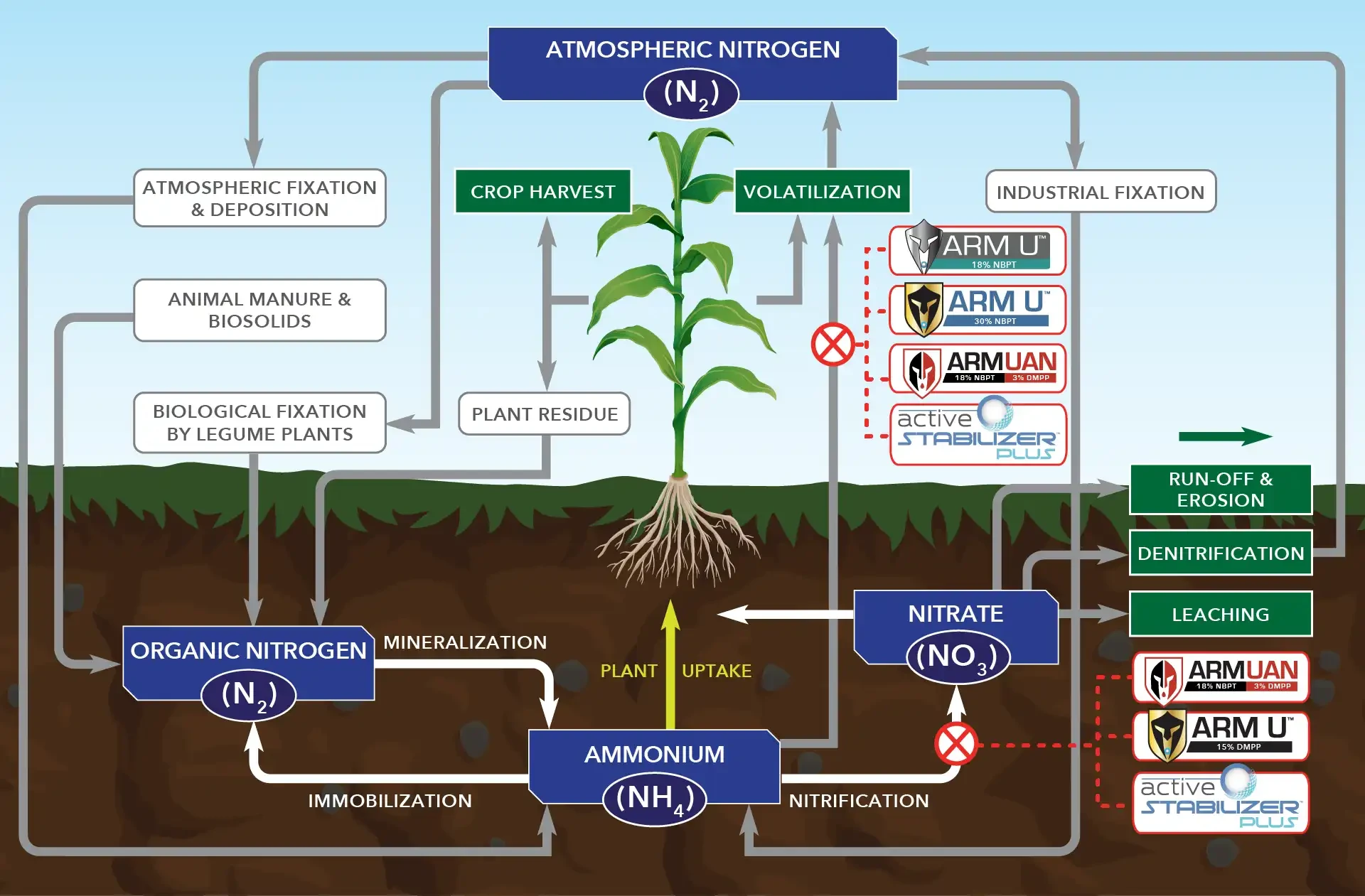
- Ammonia Volatilization: When it happens: Immediately after urea is applied and begins converting to ammonium. What happens: Nitrogen escapes as ammonia gas (NH₃) into the atmosphere. Risk factors: Surface-applied fertilizer, warm temperatures, high pH soils, moist conditions drying rapidly.
- Nitrate Leaching: When it happens: After nitrogen converts to nitrate (NO₃⁻). What happens: Nitrate moves downward through the soil profile with water, beyond the root zone. Risk factors: Heavy rainfall, sandy soils, excessive irrigation.
- Denitrification: When it happens: In saturated or compacted soils when oxygen is limited. What happens: Nitrate is converted by bacteria into nitrous oxide (N₂O) or nitrogen gas (N₂) and lost to the atmosphere. Risk factors: Waterlogged fields, poor drainage, heavy clay soils.
- Depending on soil type, temperature, and moisture, nitrogen losses can reach 20–50% or more. Unprotected nitrogen means unpredictable performance, wasted investment, and lost yield potential in your fertility program.
Why Stabilizers Matter
Nitrogen stabilizers like NBPT and DMPP help control when nitrogen transitions between chemical forms — slowing down loss pathways and ensuring more nitrogen remains plant-available. They don’t “lock up” nitrogen permanently. They temporarily delay key enzyme-driven or microbial-driven conversion processes, giving your crop a better chance to access the nitrogen before it’s lost, optimizing your nitrogen fertility.
How NBPT and DMPP Work:
- NBPT (N-(n-butyl) thiophosphoric triamide): Action: Inhibits the urease enzyme. Benefit: Slows down the conversion of urea into ammonium, reducing the amount of ammonia gas that can volatilize off the soil surface. Timing Impact: Protects nitrogen during the first 7–14 days after application — the most vulnerable period.
- DMPP (3,4-dimethylpyrazole phosphate): Action: Inhibits the nitrifying bacteria that convert ammonium into nitrate. Benefit: Delays nitrate formation, reducing risk of leaching and denitrification. Timing Impact: Extends the window of stable ammonium nitrogen for 6–10 weeks depending on conditions.
Comparing Nitrogen Stabilizers:
DCD vs NBPT and DMPP: When it comes to protecting your nitrogen investment, not all stabilizers are created equal. DCD (Dicyandiamide) is an older nitrification inhibitor developed decades ago. While it does slow the conversion of ammonium to nitrate, its performance is highly inconsistent and strongly dependent on environmental conditions.
DCD requires large volumes to be effective, has a short window of activity, and offers no protection whatsoever against surface ammonia volatilization losses — a major risk in urea and UAN systems. In contrast, NBPT (N-(n-butyl) thiophosphoric triamide) and DMPP (3,4-dimethylpyrazole phosphate) represent modern, precision-engineered technologies designed to protect nitrogen across multiple pathways. NBPT is the industry gold standard for urease inhibition, blocking the breakdown of urea at the soil surface and dramatically reducing volatilization losses — something DCD simply cannot do.
DMPP is a superior nitrification inhibitor compared to DCD, requiring much lower use rates, activating faster in the soil, and maintaining its effectiveness longer under a wider range of temperatures and moisture conditions. In short: DCD protects only one part of the nitrogen cycle, inconsistently. NBPT and DMPP protect multiple stages of the nitrogen cycle, precisely and reliably. Choosing DCD-based stabilizers is choosing yesterday’s technology for today’s farms. Choosing NBPT + DMPP is protecting your nitrogen from the moment it hits the field to the moment your crop needs it most.
Summary: What This Means for Growers
When you protect nitrogen with NBPT and DMPP, you: Retain more of the nitrogen you paid for, Improve nitrogen use efficiency (NUE), Support stronger early vegetative growth, Reduce greenhouse gas emissions (N₂O), Protect yield potential even in unpredictable weather conditions. Good nitrogen management isn’t just about applying the right rate. It’s about applying the right rate and protecting it long enough to do its job for optimal crop fertility.
Taurus Nitrogen Cycle diagram