
TSN

Field Ready Nitrogen Protected with DMPP & NBPT
tsn-watermark

TSN: Maximize Nitrogen Efficiency & Protect Your Fertility Investment

Nitrogen is one of the most important drivers of crop yield — but also one of the most vulnerable. Every year, millions of dollars’ worth of nitrogen fertilizer is lost to volatilization, leaching, and denitrification before plants ever have a chance to use it. Unprotected nitrogen doesn’t just hurt your bottom line. It reduces efficiency, weakens plant health, contributes to greenhouse gas emissions, and erodes long-term soil fertility. That’s why Taurus, The Fertility Company, offers TSN: a field-ready stabilized nitrogen solution designed to protect every tonne you apply.

GUARANTEED ANALYSIS
TSN
46-0-0
Tap any nutrient to see what it does in the plant
46%
Total Nitrogen (N)
Builds proteins and chlorophyll. Drives canopy growth, photosynthesis and overall yield potential.
factory pre-treated
Stabilizer (NBPT + DMPP)
Urease inhibitor. Slows urea conversion to cut ammonia volatilization and protect applied nitrogen.
Finished urea prill, with NBPT and DMPP stabilizer chemistry.
Taurus · The Fertility Company
TSN | Field-Ready Nitrogen, Protected
Protected with NBPT & DMPP

Keep the nitrogen you paid for.

Untreated urea can lose 20–50% of its nitrogen to volatilization, leaching, and denitrification before your crop ever uses it. TSN is field-ready 46-0-0 with a dual-action stabilizer built in — so more of every tonne stays in the ground, available, and working.
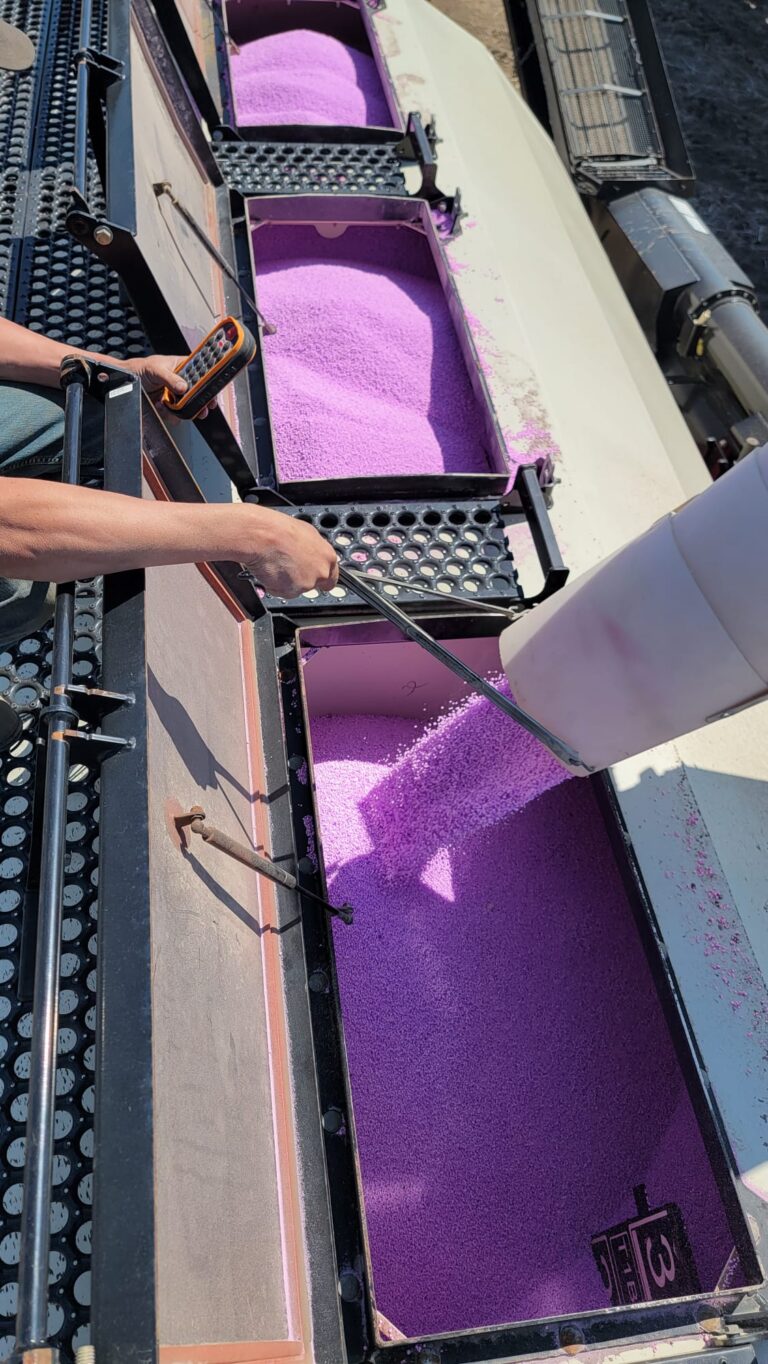
TSN field-ready stabilized nitrogen 46-0-0
0
applied N retained
across all soils
0%
up to — less ammonia volatilization vs untreated urea
0%
up to — lower nitrous oxide emissions
0×
more N held as stable urea (21-day study)
$0
net profit per acre on canola

1 Agronomics

Nitrogen you apply is worthless if it never reaches the crop.

After urea hits the soil it starts breaking down immediately. Unprotected, it gasses off as ammonia, leaches below the roots, or denitrifies into the air. TSN’s dual-action system protects it above and below ground.

NBPT · Urease Inhibitor

Stops the gas-off at the surface

NBPT (N-(n-butyl) thiophosphoric triamide) inhibits the urease enzyme, slowing urea conversion and giving rain time to move nitrogen into the soil. More N stays put instead of venting as ammonia.

DMPP · Nitrification Inhibitor

Holds N in the stable form longer

DMPP (3,4-dimethylpyrazole phosphate) slows nitrification, keeping nitrogen in the ammonium form. Less nitrate means less leaching on sandy soils and less denitrification on heavy ground.
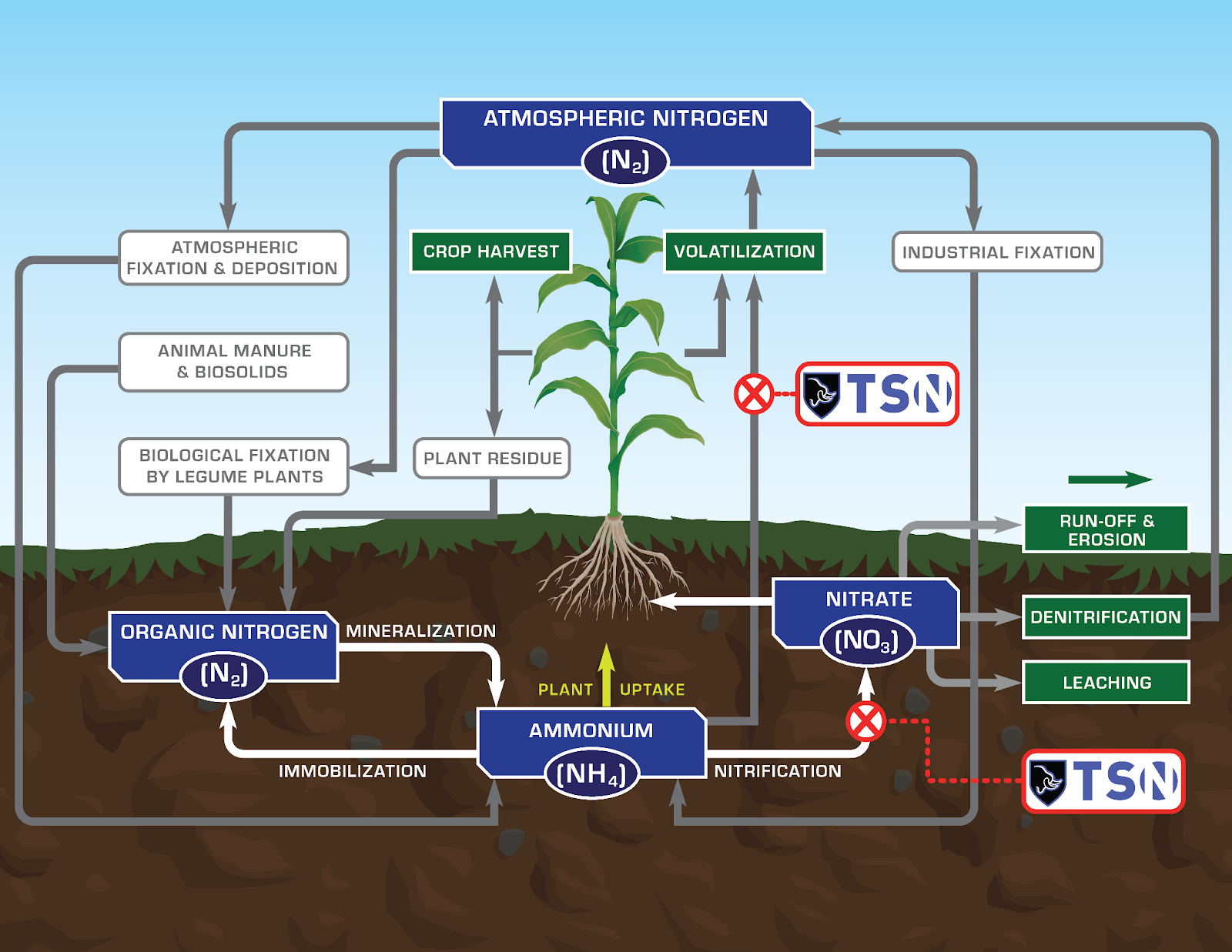
The nitrogen cycle and where TSN protects against loss
The nitrogen cycle — TSN protects at the volatilization and nitrification steps where untreated urea bleeds value.
What actually reaches the crop · on average
TSN (NBPT + DMPP)~92% delivered
Untreated urea~63% delivered
Delivered to the cropLost to the air & water

On average, TSN delivers about 66 lbs/ha more nitrogen into the soil bank than untreated urea — and held twice as much nitrogen in stable urea form in a 21-day University of Manitoba incubation study.

Best
Ammonia volatilization
−79%
up to, vs untreated urea
Nitrous oxide (N₂O)
−18%
up to, vs untreated urea
Held as stable urea
more than untreated · 21-day incubation

University of Manitoba trials · loss to volatilization (lbs N/ha, applied at 220 lbs N/ha)

Sandy · Broadcast

Roseisle, MB
Untreated urea lost131.9
CSN (single inhibitor) lost71.9
TSN lost35.1
TSN saved 84% of applied N — ~96.8 lbs/ha kept in the field.

Loamy Sand · Broadcast

Carman, MB
Untreated urea lost129.9
CSN (single inhibitor) lost62.5
TSN lost26.9
TSN saved 88% of applied N — ~103 lbs/ha kept in the field.

Sandy · Shallow Band

Roseisle, MB
Untreated urea lost40.0
CSN (single inhibitor) lost30.8
TSN lost9.2
TSN saved 92% of applied N even when banded.

Loamy Sand · Shallow Band

Carman, MB
Untreated urea lost27.9
CSN (single inhibitor) lost34.1
TSN lost~2
TSN saved 93% — while the single-inhibitor product lost more than untreated.

Soil type doesn’t save you. Broadcast losses were nearly identical on sand and loam (131.9 vs 129.9 lbs/ha). The application method drives the loss — and TSN closes it on every soil.

2 Economics

Stop paying for nitrogen that gasses off the field.

At a ~$10/acre investment, TSN protects the most expensive input on most farms. Retained nitrogen shows up as retained yield — here is what the numbers say, and a calculator to run your own acres.

Published ROI · Taurus 2025 analysis
Per acreInvestmentYield savedRevenue savedNet profit
Wheat ($6/bu)−$10.006.6 bu+$39.00$29.00
Canola ($13/bu)−$10.005.7 bu+$74.00$64.00

Run your acres

Calculator
ac
lb N/ac
$/bu
$/ac

Your nitrogen, protected

Result
N lost · untreated urea
0
lb N/ac never reaches the crop
With TSN
N lost · TSN
0
lb N/ac — the rest stays put

TSN keeps 0 more pounds of nitrogen per acre in the ground than untreated urea at this rate and placement.

That retained nitrogen is worth roughly $0 per acre in saved yield. After the $10/ac TSN investment, that is a net $0 per acre — about 0 bu of wheat you would otherwise lose to the air.
 
Extra N retained
0
lb across the farm
Net profit
$0
after TSN cost
Return on investment
per dollar on TSN

3 Logistics

Field-ready out of the truck. No blending. No guesswork.

TSN is a finished 46-0-0 with both inhibitors built in — load it, spread it, seed it. You handle it like any urea; it works like a smart nitrogen system.

Dual inhibitor, factory-built

NBPT and DMPP are pre-treated on every prill. No in-shed impregnation, no on-the-go injection, no mixing errors at the spreader.

Broadcast, banded, or incorporated

Even protection holds across application methods and across cold or warm soils — urease and nitrification stay active well below the temperatures most growers expect.

Drops into your existing program

Compatible with standard seeding and fertilizer equipment. Same calibration, same storage, no extra passes.

Buys you a weather window

By slowing volatilization, TSN gives rain time to move nitrogen into the soil — widening the gap between application and the rainfall you can’t control.

The placement rule · every cm shallower costs money

Placement depthRiskPotential N lossLoss with TSN
0 cm (surface)Extreme50%< 5%
2.5 cm (1″)High25%< 3%
5.0 cm (2″)Moderate10%< 1%
7.5 cm (3″)Safe zone< 5%0%

Every centimeter of shallower placement raises nitrogen loss by roughly 7–10%. TSN protects the application you can actually make — not the perfect one.

Protect your nitrogen. Protect your profits.

A smart solution designed to protect your nitrogen investment, from Taurus — The Fertility Company.

Contact Taurus Today
TSNTaurus Smart Nitrogen · The Fertility Company
View on taurus.ag
Research, assumptions, and how the math works

Volatilization and N₂O figures are derived from third-party controlled-environment incubation studies conducted by the University of Manitoba (2021, 2023, 2025) by Dr. Francis Zvomuya and Dr. Theresa Adesanya. The 2025 study ran 21 days at 25°C and 50% relative humidity using Roseisle sandy soil and Carman loamy sand (0–15 cm layer), with urea applied at 100 kg N/ha in a completely randomized design with four replications; ammonia losses were reported as cumulative volatilization. “Up to 79% reduction in ammonia volatilization” and “up to 18% reduction in nitrous oxide” reflect Taurus published product claims. CSN refers to a competitor single-inhibitor stabilized nitrogen; TSN is the Taurus dual-inhibitor (NBPT + DMPP) product; UTC is the untreated control.

ScenarioUntreated lossTSN lossN saved by TSN
Sandy broadcast (Roseisle)131.9 lb/ha (59%)35.1 lb/ha (84% saved)~96.8 lb/ha
Loamy broadcast (Carman)129.9 lb/ha (58%)26.9 lb/ha (88% saved)~103 lb/ha
Sandy shallow band (Roseisle)40 lb/ha (18%)9.2 lb/ha (92% saved)~21.6 lb/ha
Loamy shallow band (Carman)27.9 lb/ha (13%)~2 lb/ha (93% saved)~17.3 lb/ha

Calculator math. N lost = rate × loss rate for the selected placement. Default loss rates: surface broadcast — untreated 59%, TSN 14%; shallow band — untreated 18%, TSN 1.4%. N saved = untreated loss − TSN loss. Yield saved = N saved ÷ nitrogen-use ratio (2.4 lb N/bu wheat, 2.8 lb N/bu canola). Revenue saved = yield saved × crop price. Net profit = revenue saved − TSN cost per acre. Ratios and price defaults averaged from 2025 FCC, Alberta Grains, and Saskatchewan Ministry of Agriculture data.

These figures are planning estimates for comparison, not an agronomic recommendation or a yield guarantee. Actual results vary with soil type, weather, placement, and rate. Confirm your program with your Taurus agronomist and soil tests. Product photography and the nitrogen-cycle diagram are courtesy of Taurus Ag (taurus.ag).

The Risk of Nitrogen Loss

After urea is applied, it immediately begins breaking down in the soil. Without protection, nitrogen is lost through: Ammonia Volatilization (Gaseous nitrogen (NH₃) escapes into the atmosphere), Leaching (Nitrogen moves downward with water beyond the root zone), Denitrification (Nitrate (NO₃⁻) is converted into nitrous oxide (N₂O) and lost to the atmosphere). Depending on soil type, temperature, and moisture, nitrogen losses can reach 20–50% or more. Unprotected nitrogen means unpredictable performance, wasted investment, and lost yield potential in your fertility program.

How TSN Protects Your Nitrogen

TSN uses a dual-action protection system combining two proven technologies: NBPT (N-(n-butyl) thiophosphoric triamide) (Inhibits the enzyme urease, reducing ammonia volatilization losses) and DMPP (3,4-dimethylpyrazole phosphate) (Slows nitrification, reducing nitrate leaching and denitrification losses). Together, NBPT and DMPP stabilize nitrogen both above and below ground. You get more nitrogen staying in the ammonium form — stable, available, and plant-usable when your crops need it most, enhancing nitrogen use efficiency.

20250507 202506000 iOS

Proven Agronomic Advantages

Up to 79% Reduction in Ammonia Volatilization (Compared to untreated urea), Up to 18% Reduction in Nitrous Oxide Emissions (Compared to untreated urea), Higher Plant-Available Nitrogen (Less loss means stronger vegetative growth, better tillering, greener canopies, and higher yield potential), Superior Nutrient Use Efficiency (More nitrogen goes into your crop — not the air or groundwater), Best ROI in Nitrogen Management (Protect your investment, maximize your return).

Field-Ready Advantages

TSN is a 46-0-0 urea product built with NBPT and DMPP, ready to be loaded, spread, and seeded with no additional handling or mixing steps. Built with even protection, Works in banded, broadcast, or shallow incorporated applications, Compatible with standard seeding and fertilizer equipment.

Guaranteed Analysis

Total Nitrogen (N): 46% Field Ready with NBPT and DMPP

TSN Nitrogen Cycle

Nitrogen cycle and where TSN works

Trial Data

TSN-Trial-Data

Product Manufacturer

Recent blogs (3)

Protect Your Nitrogen. Protect Your Profits.

TSN (new) logo
TSN
A smart solution designed to protect your Nitrogen investment