

In 2026, Should Nitrogen Still Be an Input We Expect to Lose?
Today’s farms are built around precision and performance. We invest in seed with advanced genetics, rely on equipment designed for accuracy and efficiency, and manage operations knowing every input needs to earn its place. And yet, nitrogen is still often managed with the expectation that a portion of it simply won’t make it to the crop.
Not because of poor management. But because nitrogen loss has long been accepted as unavoidable.
With today’s understanding of nitrogen behaviour, is accepting loss still the most efficient approach, or is it time to manage nitrogen the same way we manage every other high-value input?
Recent University of Manitoba research helps answer that question by showing where nitrogen is still being lost, even in well-managed systems, and what changes when efficiency becomes the goal.
How Nitrogen Is Lost
Nitrogen loss isn’t a mistake. It’s a predictable response to exposure, moisture, and soil biology. Before talking about efficiency, it helps to understand how nitrogen actually leaves the system.
| Type of loss | What’s happening | Where risk shows up |
|---|---|---|
| Volatilization | Nitrogen escapes into the air as a gas when urea sits too close to the soil surface | Surface and shallow-banded applications, warm conditions, limited rainfall |
| Leaching | Nitrogen moves downward with water, below the crop’s root zone | Heavy rainfall, irrigation, lighter soils |
| Denitrification | Nitrogen is converted into gases in saturated soils and lost | Water-logged soils, compacted or heavy soils |
The important part is this: loss is measurable, and it happens in specific conditions. That’s why modern nitrogen management focuses on reducing exposure and protecting nitrogen during the most vulnerable windows.
Trend 1: Nitrogen Efficiency
Efficiency isn’t about applying more nitrogen. It’s about keeping more of what’s already applied.
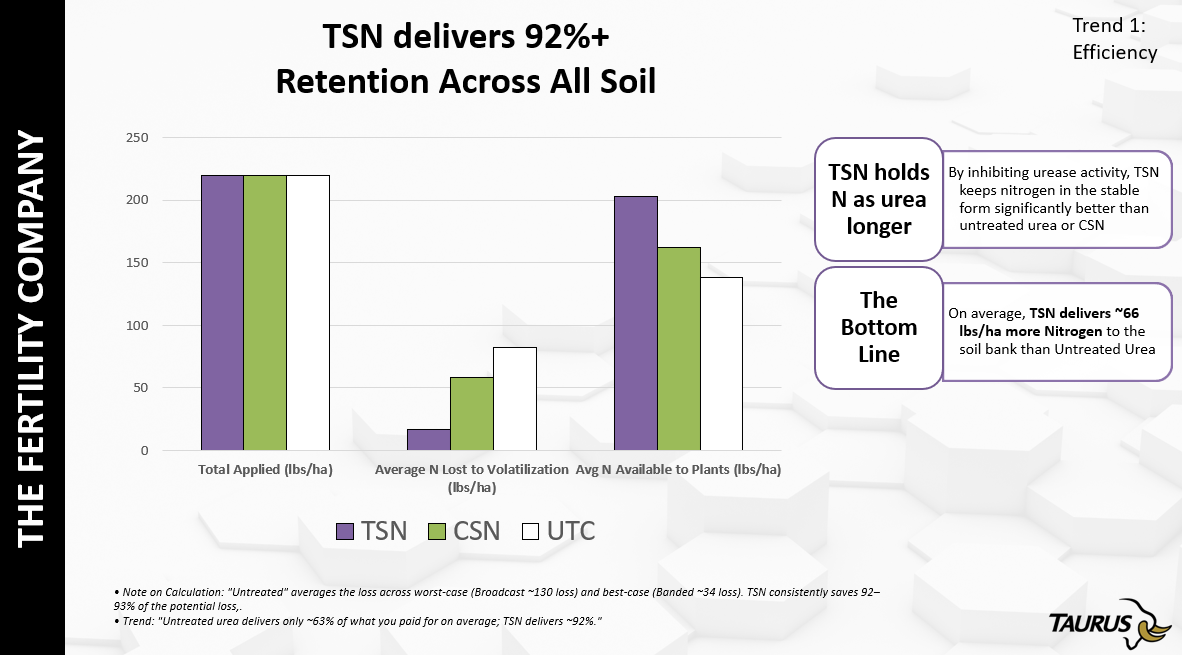
In recent trials comparing untreated urea to stabilized nitrogen, untreated urea delivered only about 63 percent of applied nitrogen. The remainder was lost, primarily through volatilization. Stabilized nitrogen consistently retained 92 percent or more of applied nitrogen.
- Less nitrogen escapes into the air
- More nitrogen remains plant-available
- Nutrient supply better aligns with crop demand
Trend 1 Continued: Longevity Matters
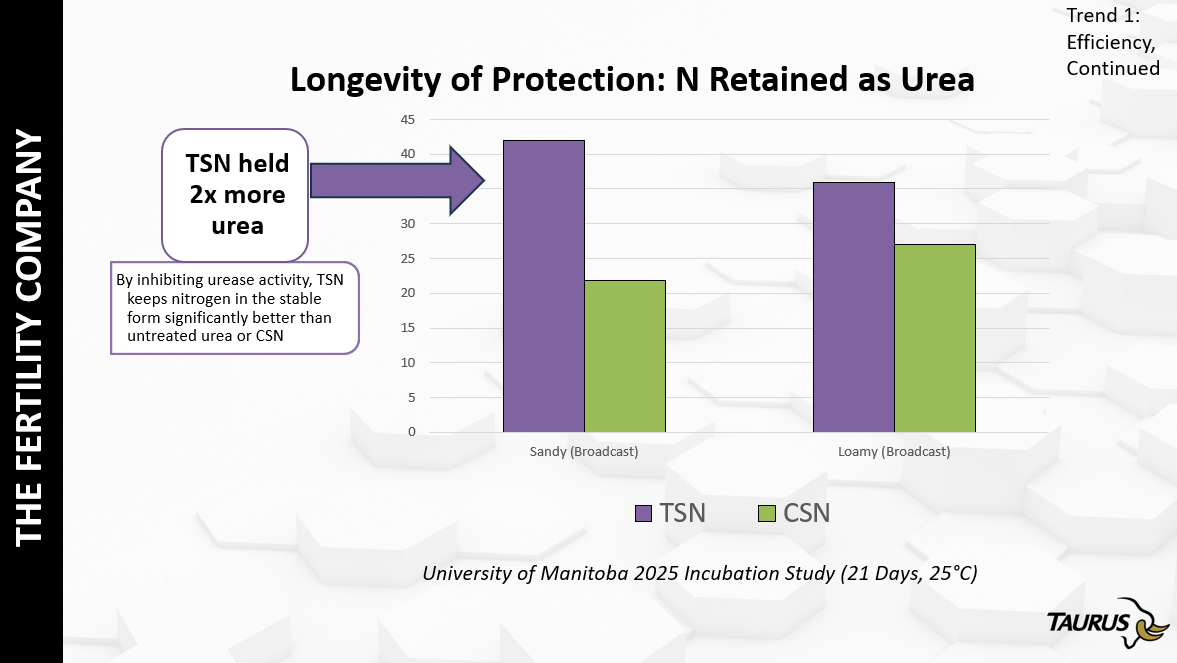
Efficiency is not just about how much nitrogen is retained. It’s about how long it remains protected. Early after application, nitrogen is most vulnerable to loss. Slowing conversion during this period is critical.
In the same trials, stabilized nitrogen remained in the urea form roughly twice as long as untreated urea. That extended protection translated into about 26 additional pounds of nitrogen per acre remaining in the soil system, not through higher rates, but through reduced loss.
Trend 2: Broadcasting Losses
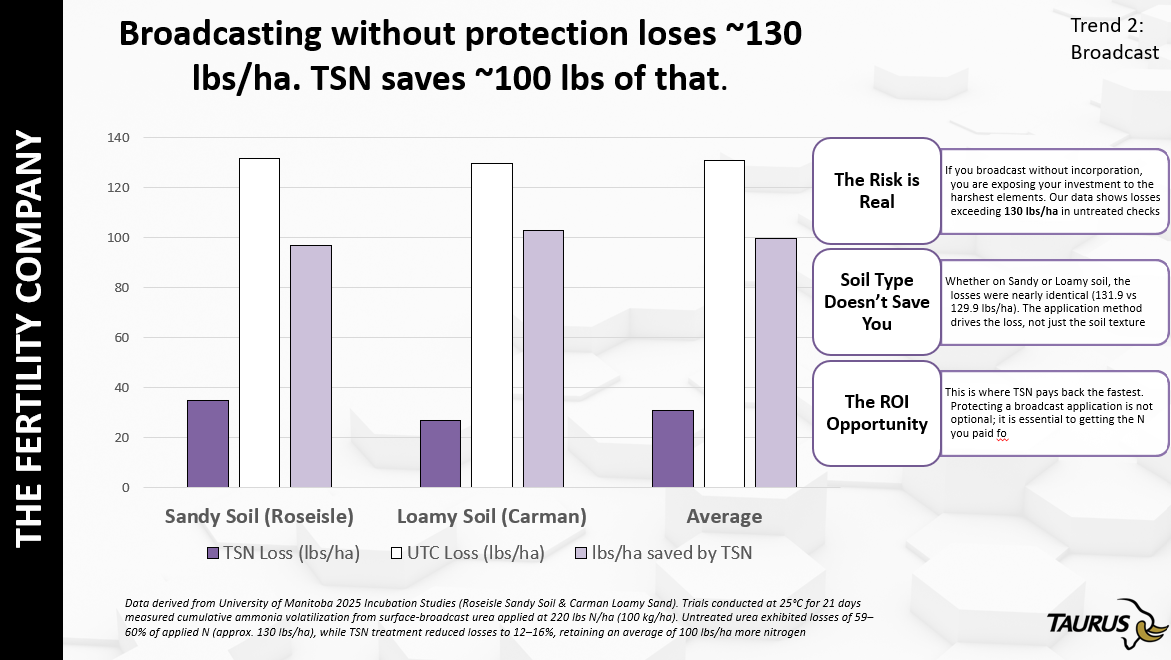
Broadcasting nitrogen without protection continues to carry the highest risk. Across both sandy and loamy soils, untreated broadcast urea lost an average of 52 pounds per acre.
Soil texture did not meaningfully change the outcome. Application method did. With stabilization, roughly 40 pounds per acre of that nitrogen was retained.
- Exposure drives loss more than soil type
- Broadcasting magnifies inefficiency without protection
- High-risk systems offer the greatest opportunity for improvement
Trend 3: Banding Reduces Risk, It Doesn’t Eliminate It
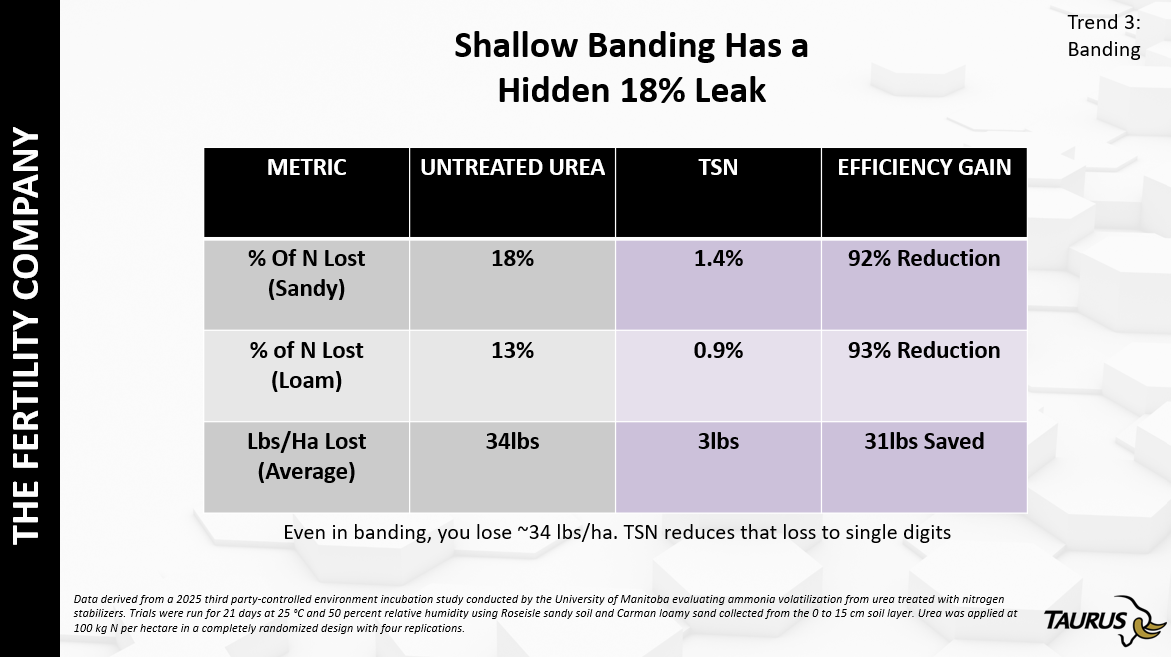
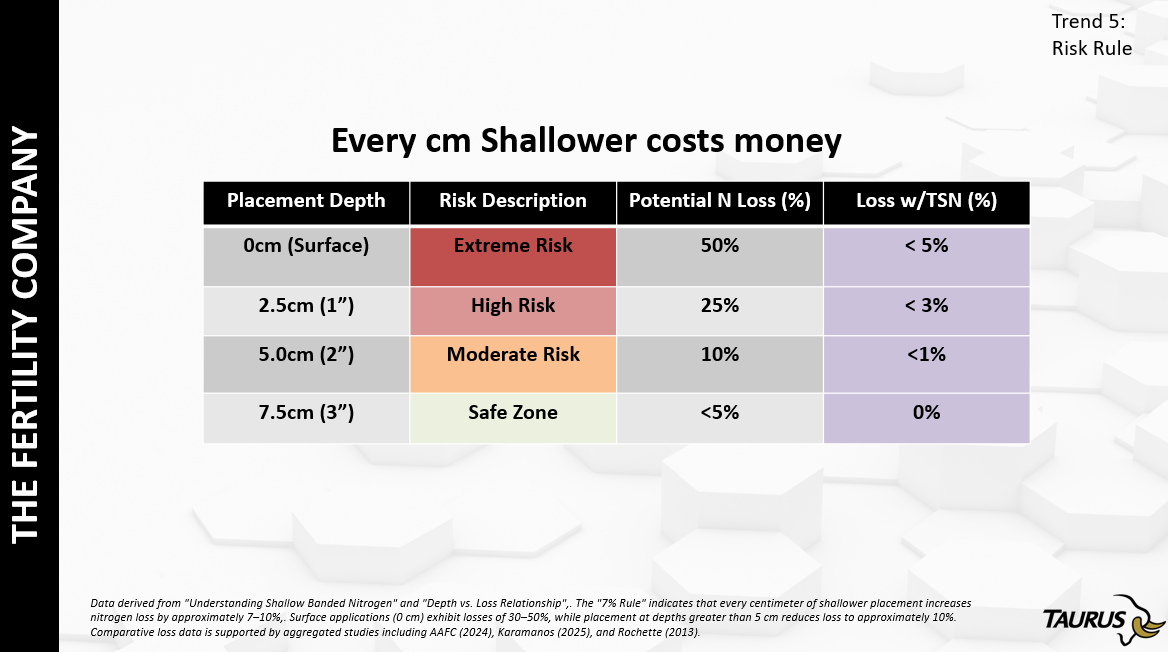
Banding is one of the most effective nitrogen placement strategies available. By moving nitrogen below the surface, exposure is reduced and efficiency improves. However, the data shows that banding alone does not fully protect nitrogen from loss.
In recent trials, untreated banded nitrogen still lost nearly 14 pounds per acre on average. That loss occurs because nitrogen remains close enough to the surface for conversion to begin before it is fully protected.
The takeaway: placement improves efficiency. Protection determines how much nitrogen actually stays available.
Trend 4: The Economics of Nitrogen Efficiency
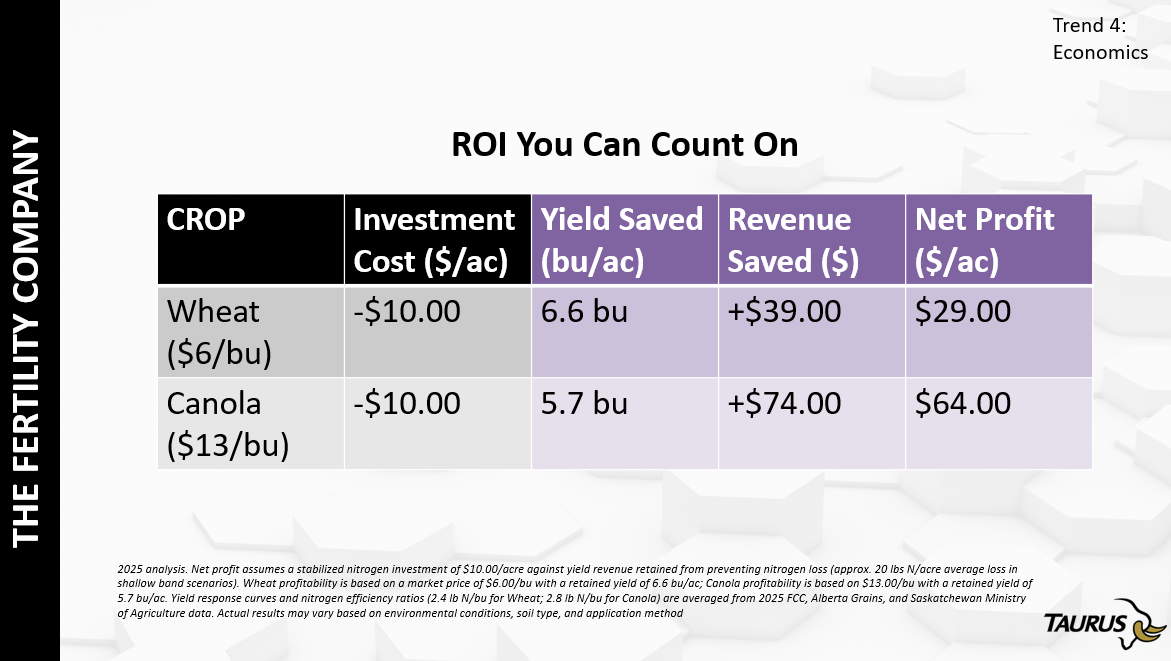
When nitrogen stays in the soil, yield loss is reduced. Economic analysis showed average yield gains of 6.6 bushels per acre in wheat and 5.7 bushels per acre in canola.
At conservative pricing, that translated to approximately $29 per acre in wheat and $64 per acre in canola. These gains came from improving nitrogen efficiency, not from increasing application rates.
How Nitrogen Stabilization Fits Into a Modern System
Stabilization works alongside placement, timing, and rate, not instead of them.
- NBPT slows the conversion of urea into ammonia, reducing loss to the air
- DMPP slows conversion into nitrate, reducing losses from leaching and denitrification
Together, they slow nitrogen’s movement into loss pathways across both broadcast and banded systems.
The Question Worth Asking
If efficiency is the standard applied to seed, equipment, and operations, should nitrogen be any different?
The science is clear. The losses are measurable. The opportunity is real. Improving nitrogen efficiency isn’t about changing everything. It’s about keeping more of what already works.

Taurus Agricultural Marketing supports Canadian growers with reliable, efficient fertility solutions grounded in agronomy, economics, and real-world performance.